Wisp needed a mischievous face and ribbons with some life in them.
Holly generated six versions of the character portrait. The selected version had the expression and ribbon motion the pass was looking for, with a mature painterly face. It went through a face-detail pass, a light polish, and the finishing treatment used for the rest of the set.
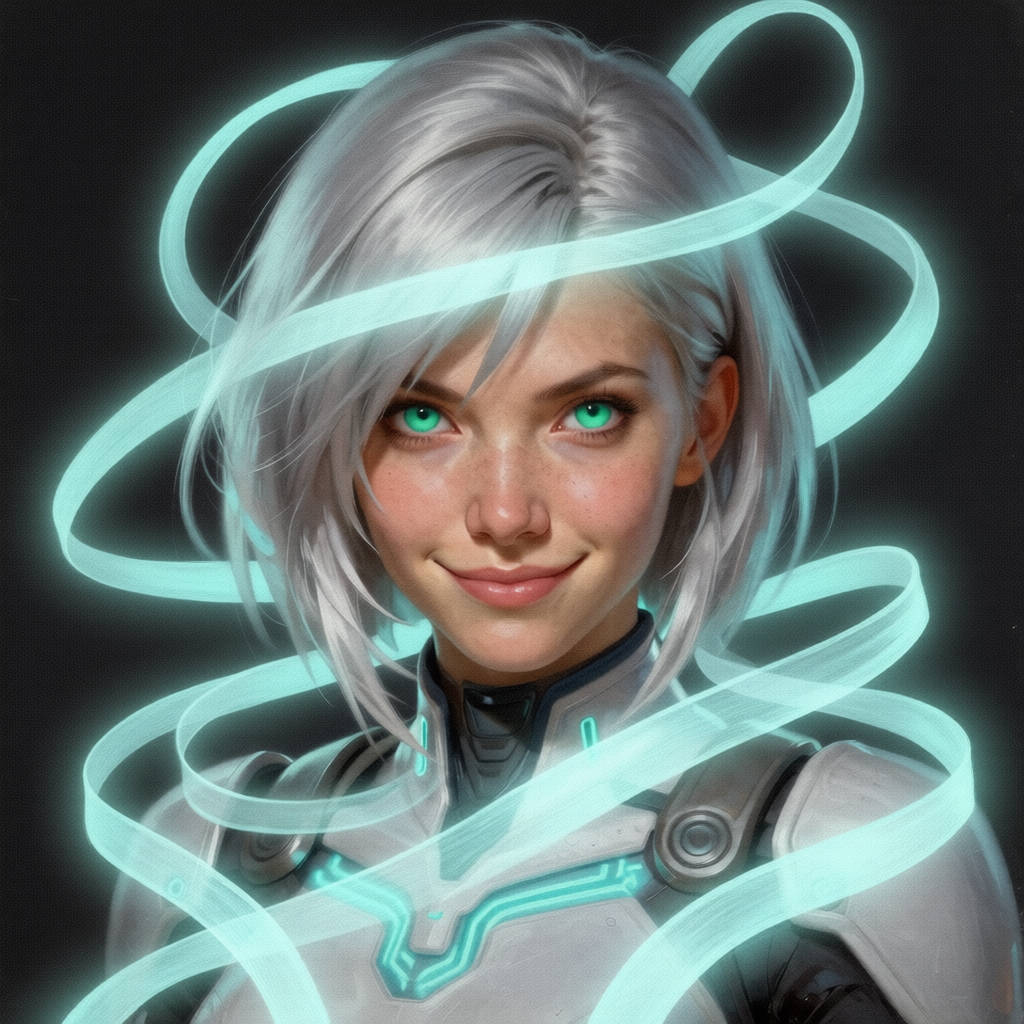
That is the part of generative art I enjoy: there is a character taking shape, and the differences between the alternatives matter. “Pretty” is a starting point. The picture still needs a personality.
Holly is the AI image director I've been developing around that process. I give her a goal; she helps turn it into configurations and pictures I can choose between. The longer-term ambition is for those choices to teach her something about my taste.
One character, several possibilities
The Wisp pass was part of art work for Hex Duel. The brief steered the portrait away from an anime look and toward the painterly treatment wanted for the game.
The candidates weren't interchangeable. The recorded comparison considered composition, mood, and the character's expression. One alternative had appealing ribbons but drifted to the right. Another still leaned too far toward anime. The selected portrait combined the strongest mischievous expression with the movement the image needed.
That makes variation useful. Different starting seeds give the generation process different starting points, producing alternatives to direct rather than a single image to accept on faith. The interesting question becomes which version carries the character best.
I don't think of the detail pass as the main creative event. The expression and composition have to be worth carrying forward first. More polish on the wrong character would still leave me with the wrong character.
Art that has to work on a card
The same job produced 36 card illustrations as wide banners. They were generated large, but intended to appear in a much smaller strip inside the game's card interface.
That destination shaped the brief: a single bold focal point and a wide cinematic composition. A card illustration has to communicate quickly. It doesn't have the same room to hold a viewer's attention as a large portrait.
The pipeline treated those uses differently. Wisp received the face-detail and polish passes. The card art intentionally skipped the portrait-detail stage because the flatter graphic treatment and small display size didn't need it. Three illustrations were redone when the first results missed the mark. The completed art received shared finishing so the set would sit together.
The batch delivered the portrait and the card illustrations. That is a concrete use of generative AI I find exciting: a character and a collection of related art made for the place they would actually appear.
Show the director what belongs together
Another Holly project explored how to generate illustrations that fit an existing visual collection. The house style used wide scenes, a dominant color, a strong light source, and soft painterly shading.
Holly was given neighboring images as references, including examples from related categories and a wider spread of the collection. That lets the directing step see the visual language instead of relying entirely on a verbal description of it.
There is a difference between asking for “painterly art” and showing what painterly means in this particular set. The references can carry relationships that are awkward to compress into a label: how much depth the scenes have, how light organizes the frame, how strongly a color washes over it.
That reference work was separate from the Wisp batch, whose style came from a shared written prefix and finishing treatment. I like having both approaches available. Sometimes the visual direction starts as a brief; sometimes there is already a collection to learn from by looking.
Give the image a gesture
Pose control is another part of the larger Holly project that matters to me. If the energy of a picture depends on how a body is arranged, I want a way to direct that arrangement.
The pose-selection work used joint coordinates to describe stance, arm span, asymmetry, raised arms, and torso lean. That is a more interesting vocabulary for this job than an opaque pose filename. It gives the system something to work with when looking for a dynamic source.
A pose guide can supply the structure while the image-generation process develops the appearance. It is another kind of creative input alongside the words, references, and model choice. The goal is to get closer to the gesture in mind without trying to express every joint angle in a sentence.
This wasn't a step used in the documented Wisp pass. It is part of what I want the broader image director to make available: more ways to shape the image than rewriting the prompt.
Teaching through choices
The teaching loop brings the alternatives back to me for a judgment. A scorer and a notebook are intended to carry information from those judgments into later proposals. I want the system to become more useful as we accumulate examples of what works for the pictures I am trying to make.
The art output is real; measured improvement in that learning loop remained unproven in the July review. Those are different stages of the project.
What I already have to work with is appealing: generate variations, choose an expression, carry a visual style across a set, and use different kinds of guidance to direct the next image. The ambition is an AI collaborator with whom taste can become an ongoing conversation—one that produces characters and pictures along the way.